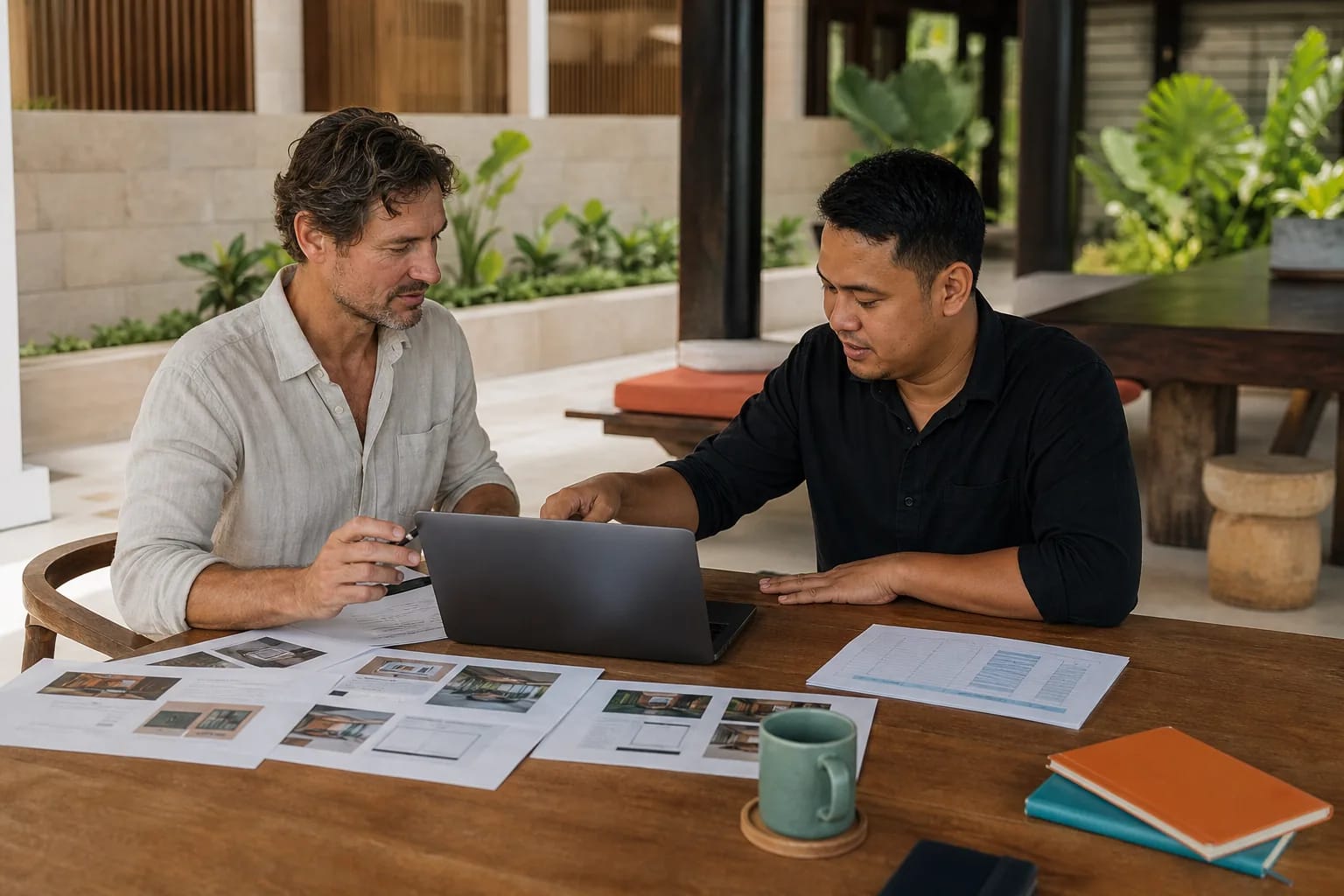
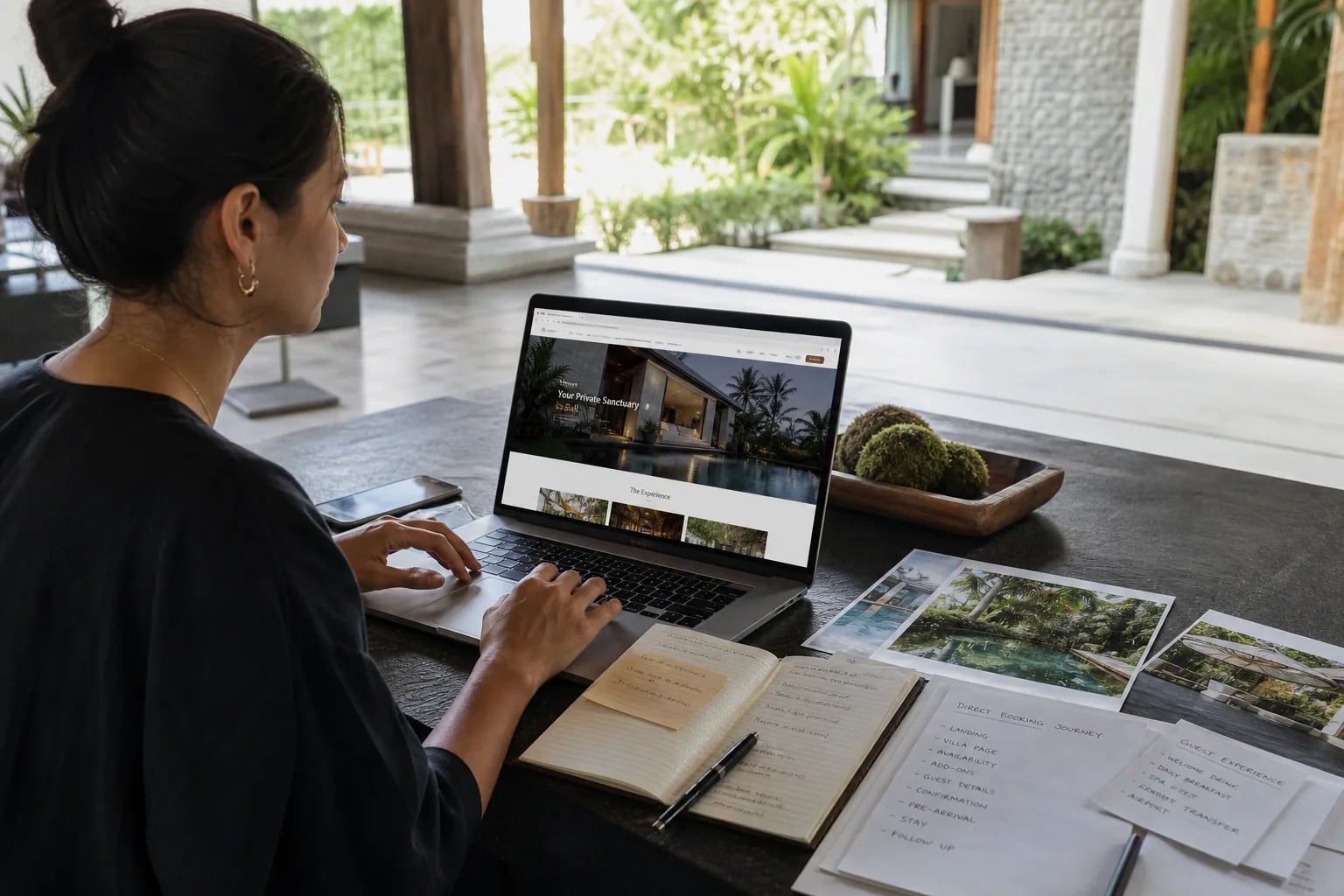
A hospitality website in Bali has to do more than look atmospheric. It needs to help a guest understand the place, compare the experience, trust the operator, answer practical questions, and take a direct next step. When one of those jobs is missing, visitors return to an online travel platform, send an unqualified message, or leave without knowing whether the property or experience fits them.
The goal is not to remove every third-party booking channel. The goal is to give the brand a strong owned surface where direct discovery, repeat guests, campaigns, partnerships, and qualified inquiries can work without depending entirely on another platform's presentation rules.
Begin with the booking or inquiry decision
Before designing the homepage, define the primary conversion. A hotel with live inventory may need a direct booking engine. A private villa may need date and guest qualification before a human conversation. A restaurant may prioritize reservations, location, menus, and event inquiries. A retreat or experience operator may need schedules, inclusions, eligibility, and an application or deposit flow.
- What action can the guest complete without staff involvement?
- What information must the team confirm manually?
- Which questions create repetitive WhatsApp or email work?
- Which inquiries are valuable, and which are usually not a fit?
- Where does availability, pricing, or policy information come from?
The website architecture should follow that operating reality. A beautiful form that sends incomplete requests to an already busy team is not an improvement.
Translate the place into specific proof
Hospitality copy often relies on broad words such as sanctuary, luxury, authentic, hidden, and unforgettable. Those words are easy to claim and difficult to evaluate. Guests make decisions through specifics: room configuration, access, neighborhood, view, noise, breakfast, pool, workspace, accessibility, staff support, transport, policies, and the character of the surrounding area.
Photography should also answer questions. Wide images establish the place, while detail images show materials, amenities, food, workspaces, bathrooms, entrances, and the real guest experience. Captions can clarify what a photograph represents instead of leaving every image as decoration.
- Show the actual room, villa, table, treatment, class, or experience being sold.
- Explain distance or travel time carefully and avoid vague location claims.
- State important inclusions and exclusions close to the relevant offer.
- Use real policies for children, pets, events, cancellations, check-in, and accessibility.
- Keep seasonal or temporary claims easy for the operating team to update.
Build pages around search intent and guest intent
A single homepage cannot answer every discovery question. A useful hospitality website usually needs distinct pages for the property or venue, accommodation or offer types, dining or experiences, location, frequently asked questions, policies, contact, and booking or inquiry. Larger businesses may also need wedding, retreat, long-stay, group, or partnership pages.
These pages help search engines understand the offer, but their first job is still to help a guest decide. Do not create dozens of thin area pages that repeat the same copy. A location page should contain original information about access, nearby places, transport, and who the area suits.
Design the direct path without creating pressure
A direct conversion path should be visible, consistent, and easy to understand. The call to action can change by context: Check availability, Reserve a table, Plan your stay, Ask about dates, Request a private event, or Join the retreat. Generic buttons such as Learn more often add an unnecessary step.
- Keep the primary action available after the guest has seen enough proof.
- Ask only for information the team will actually use.
- Show what happens after submission and when the team normally replies.
- Make phone, email, WhatsApp, map, and booking actions clear on mobile.
- Track successful inquiries and bookings without sending personal form content into analytics.
Connect the website to real operations
The strongest website is still fragile if availability, rates, menus, schedules, and policies become outdated. During planning, decide which system owns each piece of information. Some content can live in a CMS. Inventory may come from a booking engine. Restaurant reservations may use a specialist platform. WhatsApp may remain a useful support channel, but it should not be the only place where essential information exists.
The project should also define who receives form submissions, who owns analytics, who can update content, how urgent fixes are handled, and how third-party integrations are monitored. This turns the site from a launch artifact into working infrastructure.
Prepare a hospitality website launch checklist
- Verify room, venue, menu, package, schedule, price, tax, and policy information with the operating owner.
- Test booking and inquiry journeys on mobile using realistic dates and guest scenarios.
- Confirm email delivery, spam protection, response ownership, and fallback contact routes.
- Compress real photography, preserve useful crops, and include descriptive alternative text.
- Validate titles, descriptions, canonical URLs, structured data, sitemap, redirects, and analytics events.
- Check maps, directions, time zone, currency language, and contact details.
- Create a maintenance routine for rates, offers, events, policies, and seasonal content.
A hospitality website earns direct inquiries when it reduces uncertainty. Place-led storytelling attracts attention, but specific proof, operational accuracy, and a clear next step are what turn that attention into a useful business conversation.
Apply the thinking